
• Principal & CEO @ SIBS Consulting Services | Doctorate in Business Administration
Most organizational challenges in nonprofits are not caused by a lack of effort.
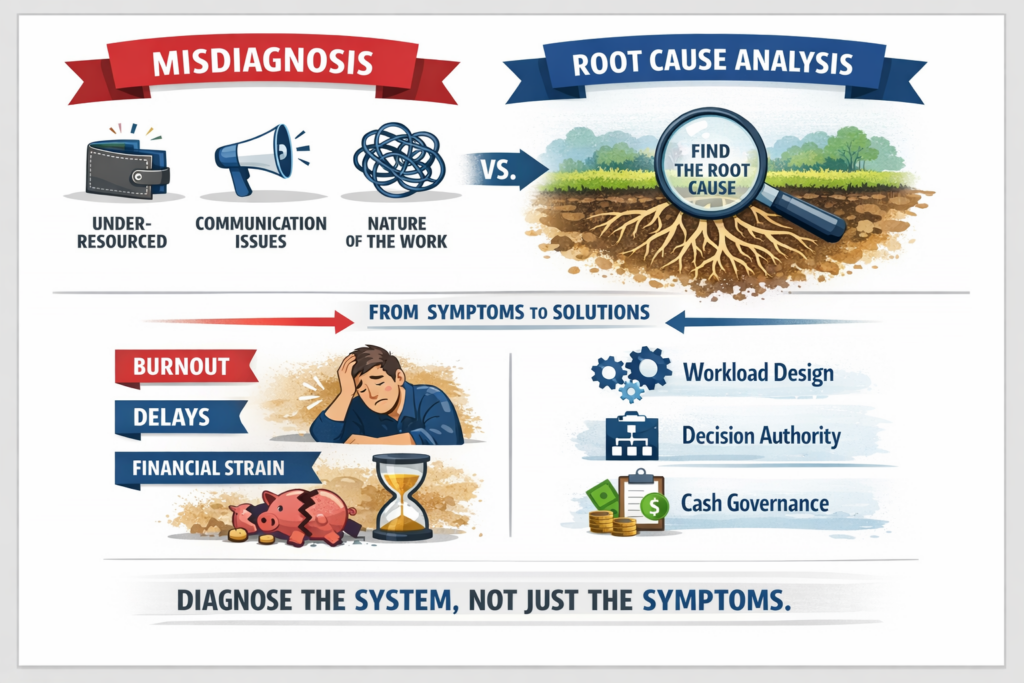
They stem from misdiagnosis. What is often described as:
• “Being under-resourced.”
• “A communication issue.”
• Or “the nature of the work.”
In practice, these are unexamined structural conditions. Root cause analysis matters because it distinguishes between symptoms and system failures.
Without it, organizations attempt to solve:
– Burnout without examining workload design
– Delays without examining decision authority
– Financial instability without examining cash governance
As a result, interventions remain surface-level—and the underlying issues persist.
A second dynamic is over-reliance on consensus as a default decision-making model.
Consensus can support inclusion. However, when it replaces role clarity, it creates ambiguity:
– Decisions are delayed because ownership is unclear
– Accountability becomes collective—and therefore diluted
– Teams default to discussion rather than resolution
Organizations do not struggle because people disagree. They struggle because no one is clearly accountable for the final decision.
At SIBS Consulting Services, the work begins with a disciplined diagnostic phase and continues through implementation:
– Root-cause analysis grounded in data and organizational patterns
– Assessment of decision pathways and cross-functional dependencies
– Design of clear governance structures (e.g., DARCI)
– Implementation of workflows that connect strategy to execution
– Ongoing support to ensure systems are used—not just designed
This approach is intentionally different.
It does not stop at recommendations.
It embeds systems into daily operations until they become sustainable.
The issue is not a lack of commitment.
It is the absence of systems that:
– Clarify who decides
– Connect data to action
– And sustain accountability over time
When those systems are in place, organizations move from:
– Discussion → decision
– Effort → execution
– Intention → impact
If these dynamics sound familiar in your organization, it may be time to examine the system—not just the symptoms.
�� Schedule a conversation: